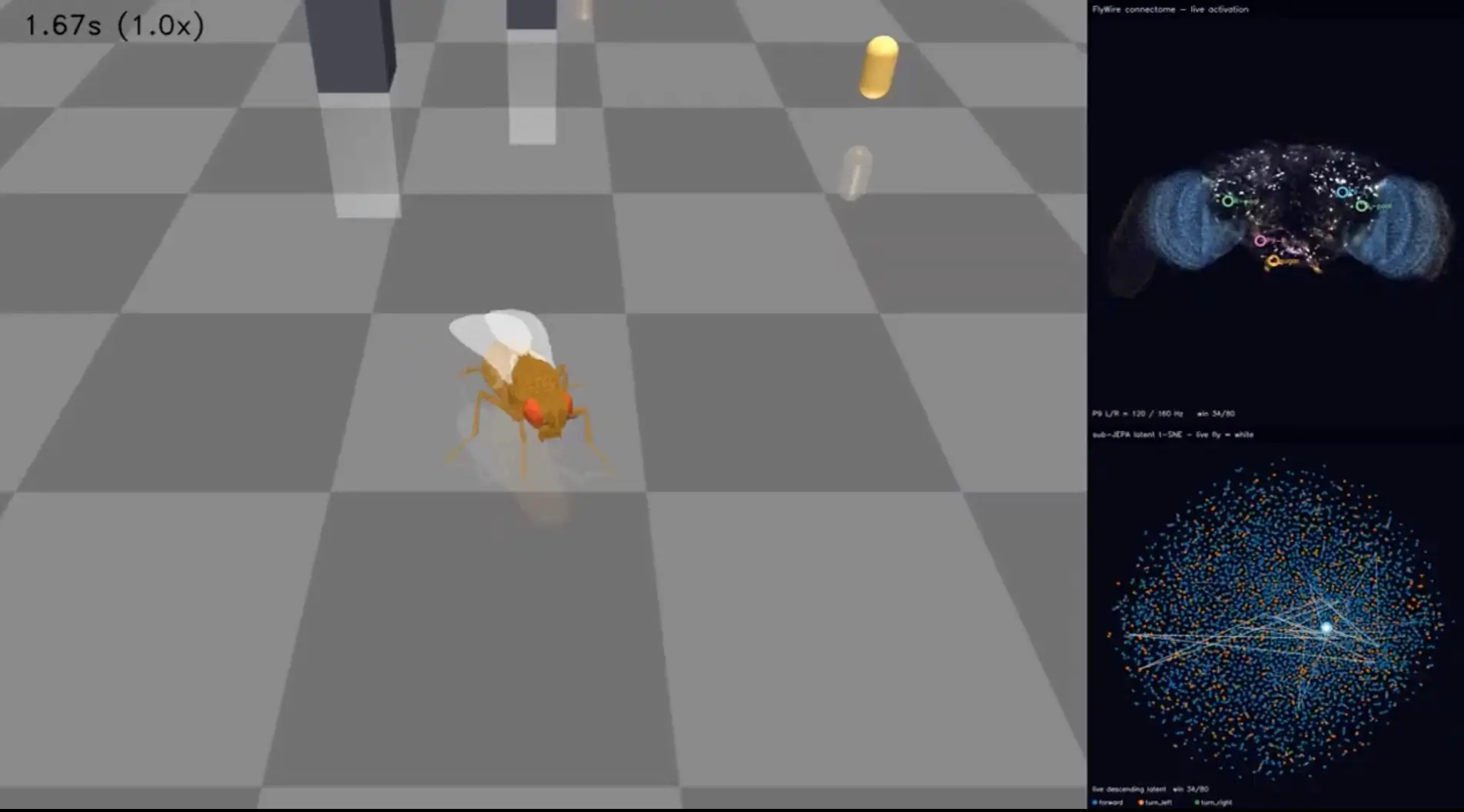
🥈 Our team Piaget finished second at Hack the World(s), the 24-hour hackathon held under the patronage of Philippe Baptiste and sponsored by Yann LeCun, who introduced the JEPA architecture at the heart of the event. Our project: Wiring the Fly Brain into a Hierarchical World Model.
The question
Most world models learn from video or simulation. We asked a different question: can a self-supervised world model learn the dynamics of a real brain? Not a metaphor for one, but an actual, complete wiring diagram? The fruit fly (Drosophila) is the only animal whose entire connectome has been mapped: roughly 139,000 neurons and 50 million synapses, released by FlyWire.
From wiring diagram to behaving fly
We took that connectome, embodied it in a physics simulation of the fly’s body (NeuroMechFly v2, in MuJoCo), and closed the sensorimotor loop: the world drives the senses, the connectome-wired brain spikes, descending neurons command the body, the body moves, and the senses change. The fly walks. On those spikes we trained what is, to our knowledge, the first JEPA world model of a complete brain, built as a hierarchy of sub-models, one per brain region, coupled along the connectome’s own sensory → integration → motor flow. All on top of the EB-JEPA framework.
Beating collapse with the brain’s own wiring
JEPAs are prone to collapse: the encoder learns to ignore its input and output a constant, trivially satisfying its self-supervised objective. The fly brain is roughly 96% silent at any instant, which makes collapse almost inevitable. So we designed a new encoder: instead of reading each neuron in isolation, it mixes every neuron with its synaptic neighbors using the real wiring. The connectome itself becomes the cure for collapse.
What we found
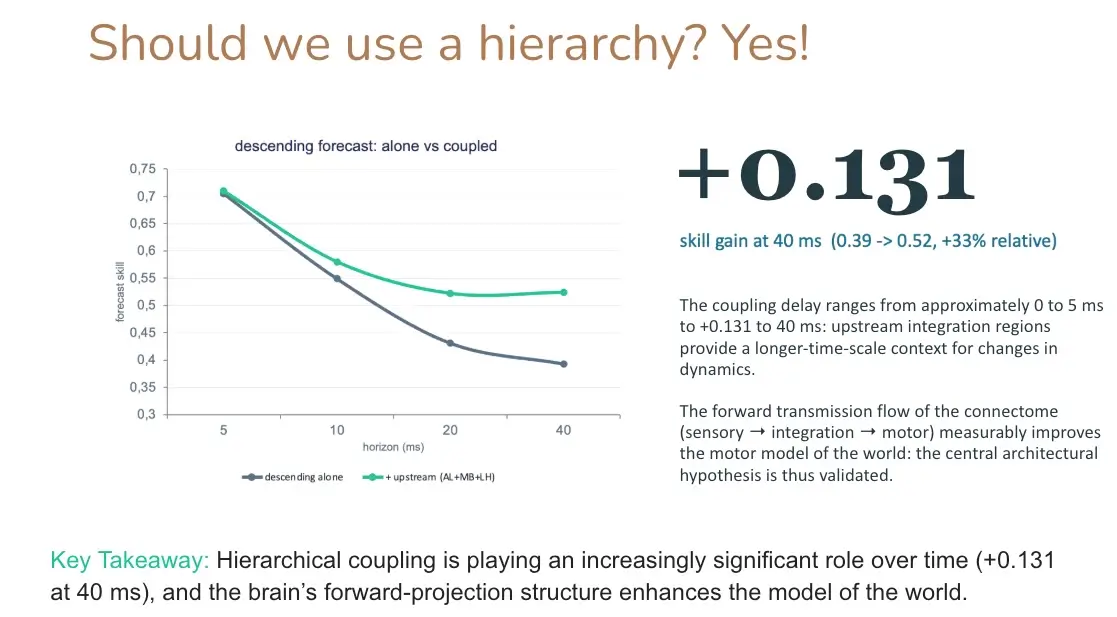
Our hierarchy of region world models learned real structure from the brain’s spikes. The clearest read came from the motor pathway: its latent state forecasts the brain’s own dynamics and linearly decodes the real motor commands the fly issues. And the result we were most excited about: coupling regions together along the connectome’s feedforward structure measurably improves prediction, increasingly so over longer horizons. In other words, the brain’s own wiring makes the world model better: the hierarchy isn’t just biologically faithful, it pays off in performance.
As Jean Piaget wrote, “intelligence organizes the world by organizing itself.” For 24 hours, so did we.
Code
We’re cleaning up the code for release: it’ll be made public once the dust settles. Repository coming soon.
Team Piaget
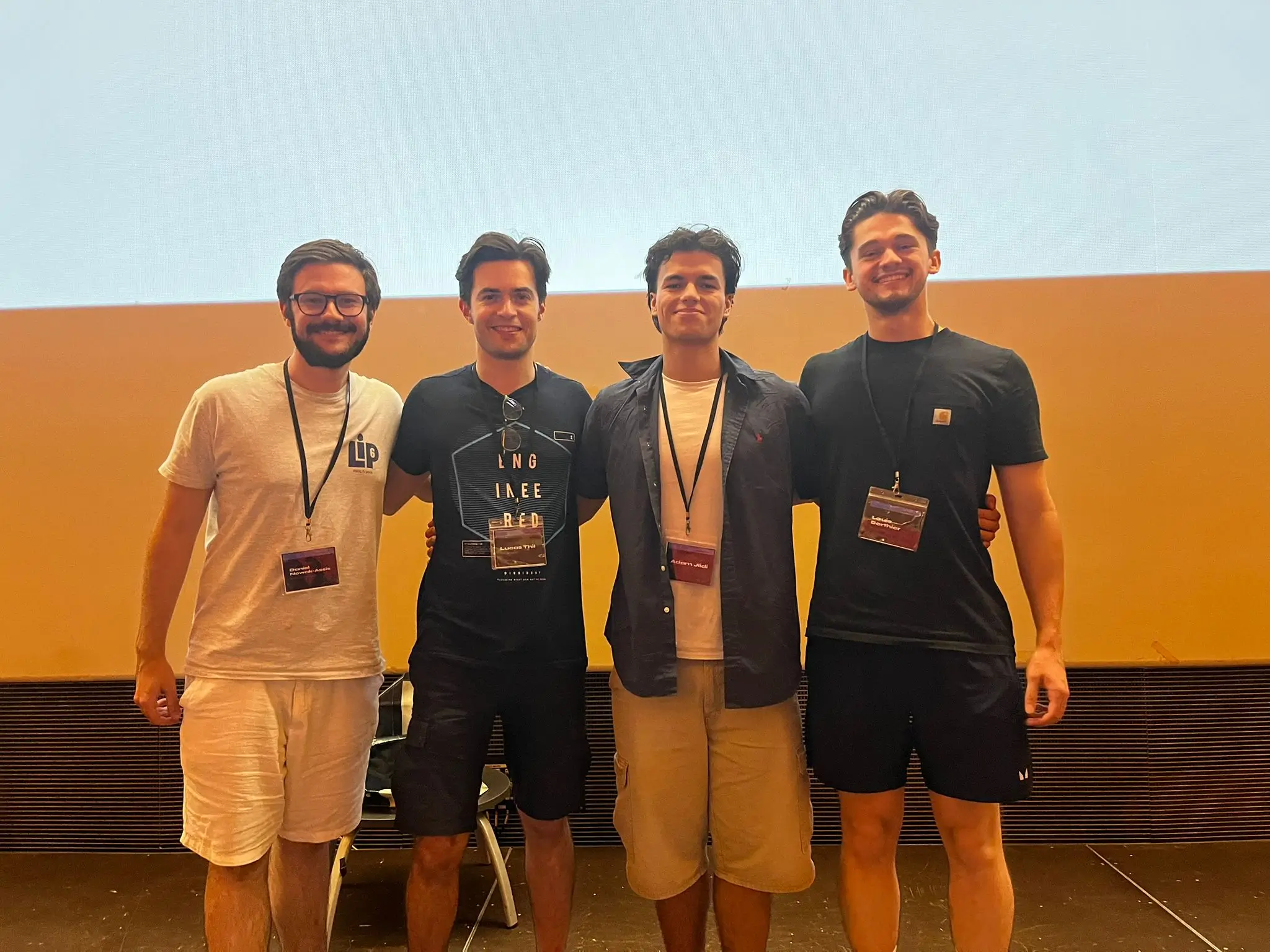
Enormous thanks to my teammates Daniel Nowak Assis, Louis Berthier, and Adam Jlidi; to the Hack the World(s) organising team for putting together such a well-run event; and to the mentors for all the patient, generous advice.
With support from ACADI, ESIEE Paris, the École Nationale Supérieure des Mines de Nancy, PR[AI]RIE-PSAI, École Polytechnique, and ORAILIX.